Technique
Microsoldering
Working on parts half a millimetre across, under a stereo microscope. This is the technique where almost every ordinary repair shop stops, and where we start.
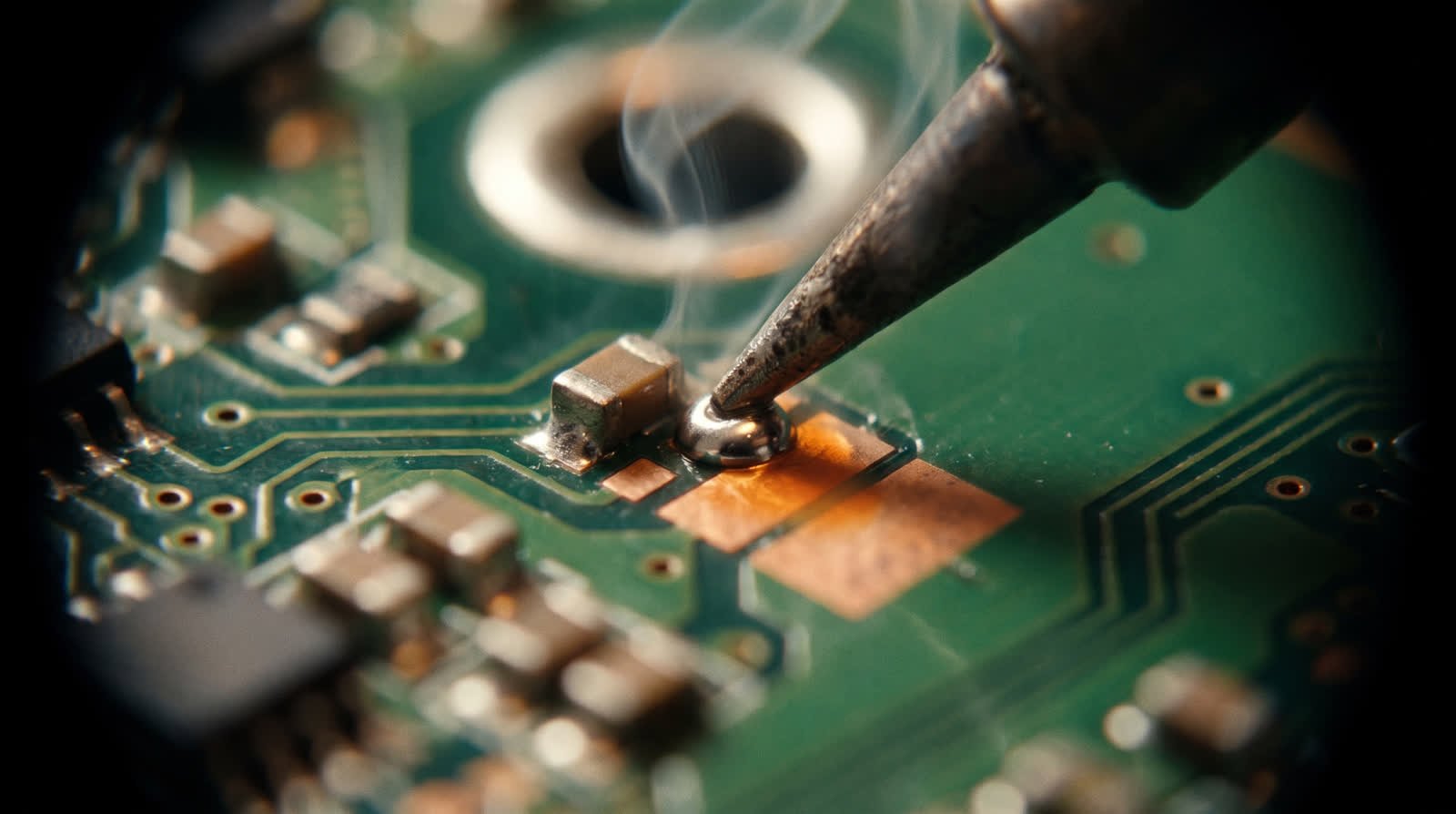
What it is
Microsoldering is soldering at a scale where the naked eye sees nothing. The resistors involved measure 0.4 by 0.2 millimetres. The traces running underneath them are thinner than a human hair. It is done with hot air, with a tip a tenth of a millimetre wide, with flux, and under a microscope that magnifies up to forty times.
The difference with ordinary repair work is not the difficulty of the soldering itself. The difference is in the searching. You have to know which of the hundreds of components on that board has failed before you touch anything at all. That takes measuring equipment, schematics and boardviews, and above all experience with what breaks on which model.
Work that falls under this
- Replacing components: resistors, capacitors, coils, diodes
- Replacing chips: charging ICs, power management, USB-C controllers, retimers
- Rebuilding traces where copper has been eaten away
- Reconstructing pads where a connection has lifted
- BGA work: lifting a chip, reballing it, putting it back
- Moving a chip from one board to another
Why not everyone does this
The equipment costs money and the skill takes years. For a shop that mostly swaps screens and batteries it does not pay off. That is why you often hear there that a machine cannot be fixed. Usually that means: not with the tools on that particular bench.
Questions about microsoldering
Is a soldered repair as strong as new?
At the spot itself yes, and often stronger, because there is more solder on it than the factory puts there. What we cannot promise is that a board that has been under liquid will never act up anywhere else. That is why we give twelve months of warranty on our soldering, and say honestly that the warranty covers the spot we repaired.
Do you work on boards someone else has already touched?
Yes, but say so. A board that has already been worked on takes more time, because we first have to work out what was done and what got damaged. We charge 35 euros extra for that, and we name it up front.
Can I see what you did?
Yes. You get photos through the microscope, before and after. That is not an extra but part of how we work, because you should be able to see where your money went.
Next step
Told somewhere else that it cannot be done?
Post it in. We will tell you honestly whether it can or cannot, and why.